Showing posts with label computer engineering. Show all posts
Showing posts with label computer engineering. Show all posts
Sunday, October 16, 2011


Friday, September 16, 2011
Automation, Production Systems, and Computer-Integrated Manufacturing (2nd Edition)

Mikell P. Groover, "Automation, Production Systems, and Computer-Integrated Manufacturing (2nd Edition)"
Publisher: Prentice Hall | 2000 | ISBN 0130889784 | PDF | 856 pages | 20.4 MB
Publisher: Prentice Hall | 2000 | ISBN 0130889784 | PDF | 856 pages | 20.4 MB
*For advanced undergraduate/ *graduate-level courses in Automation,Production Systems, and Computer-Integrated Manufacturing. This exploration of the technical and engineering aspects of automatedproduction systems pres the most advanced, comprehensive, and balanced coverage of the subject of any text on the market. It covers all the major cutting-edge technologies of production automation andmaterial handling, and how these technologies are used to construct modern manufacturing
systems.
Schaum's Outline of Electric Circuits

Publisher: McGraw-Hill | ISBN: 0071393072 | edition 2002 | PDF+HTML | 400 pages | 26,22 mb
This new edition of Schaum's Outline of Electric Circuits give readers a thorough foundation in the theory and operation of electric circuits.
This bestselling outline combines brief descriptions of theory with illustrative examples, solved problems, and supplement problems to provide a direct and effective tool and methodology for learning.
Download
Sunday, August 28, 2011

Monday, July 11, 2011
ELECTRONIC PRINCIPLES BY ALBERT MALVINO

ISBN:0070634246
ISBN-13:9780070634244,978-0070634244
Publishing Date: 2006
Publisher: Tata Mgraw Hill
Edition: 7th
Download
Megashare
Megashare
Mihd.net
Megaupload
Fileserver
Mediafire
Saturday, July 2, 2011
Computer Networking: A Top-Down Approach Featuring the Internet

Computer Networking: A Top-Down Approach Featuring the Internet By Keith W. Ross, James F. Kurose
Publisher: Addison Wesley 2000 | 599 Pages | ISBN: 0201612747 | PDF | 8 MB
Publisher: Addison Wesley 2000 | 599 Pages | ISBN: 0201612747 | PDF | 8 MB
Certain data-communication protocols hog the spotlight, but they all have a lot in common. Computer Networking: A Top-Down Approach Featuring the Internet explains the engineering problems inherent in communicating digital information from point to point. The top-down approach mentioned in the subtitle means the book starts at the top of the Open Systems Interconnection (OSI) protocol stack--with the application layer--and works its way down through the other six layers until it reaches bare wire. The approach is definitely theoretical--don't look here for instructions on configuring Windows 2000 or a Cisco router--but it is relevant to reality and should help anyone who needs to understand networking as a programmer, system architect or even administration guru.
The treatment of the network layer, where routing takes place, is typical of the style overall. In discussing routing, authors Kurose and Ross explain (by way of lots of clear, definition-packed text) what routing protocols need to do: find the best route to a destination. They then present the mathematics that determine the best path, show some C code that implements those algorithms and illustrate the logic with excellent conceptual diagrams. Real-life implementations of the algorithms--including Internet Protocol (both IPv4 and IPv6) and several popular IP routing protocols--help you make the transition from pure theory to networking technologies.
uploading
filesonic
turbobit
Computer Networks - Andrew S. Tanenbaum - 4th Edition

From the Publisher
This classic best-seller has been completely revised and updated to reflect networking and internetworking technologies that will be most critical for years to come.
Award-winning educator and researcher Andrew S. Tanenbaum explains how computer networks work inside--from the hardware technology up to and including the most popular Internet application protocols. Throughout the book are running examples of ATM and the Internet.
Tanenbaum's extensive coverage of the Internet, Asynchronous Transfer Mode (ATM) and wireless networking makes Computer Networks the first book to cover all three of these essential technologies, in addition to explaining the fundamental principles behind all computer networking. Tanenbaum clearly presents:
Internet applications such as the World Wide Web, Java, email, Usenet, multimedia, the Mbone, and the Domain Name System
Network security, including secret- and public- key algorithms, authentication protocols, and digital signatures.
TCP/IP and the latest internetworking technologies such as Mobile IP and IPv6 which are built atop the Internet's protocols
ATM: How it works in wide area (B-ISDN) and LAN environments
Local area networks, including IEEE, 802, FDDI, HIPPI, and Fibre Channel
The major wireless and mobile technologies, including such as AMPS, GSM, CDMA, and CDPD
Detailed discussions of the principles, modeling, and performance of protocols in various layers
Discussions of the underlying hardware technologies, from fiber optics to wireless communication
With 250 exercises, a separate solutions manual, protocol simulation software files written in C and figure files available for downloading, the book is perfect for students and networking professionals. --This text refers to an out of print or unavailable edition of this title.
Download
Friday, June 24, 2011
PROGRAMMING AND CUSTOMIZING THE PIC MICROCONTROLLER

Download
THE DEFINITIVE GUIDE TO THE ARM CORTEX-M3, 2 ED BY JOSEPH YIU

Donwload
Megaupload
Sunday, June 19, 2011
SENSORS HANDBOOK BY SABRIE SOLOMAN

Product Details
- Hardcover: 816 pages
- Publisher: McGraw-Hill Professional; 1 edition (May 1, 1998)
- Language: English
- ISBN-10: 0070596301
- ISBN-13: 978-0070596306
Product Description
The first all-inclusive reference on sensors in industry and science! Finally -- a current and comprehensive guide to commercially available sensors that will help engineers, scientists, and technicians pinpoint the optimum sensor for any given application, enabling you to check the specs for your required component more easily and more reliably than ever! Also features: specific advice on selecting and using the optimum sensor for any given application; full descriptions of hands-on applications in various industries; and practical insights on how to ensure more flexible control via sensors.
From the Back Cover
The first all-inclusive reference on sensors in industry and science! Helps engineers, scientists, medical researchers, and technicians pinpoint the optimum sensor for any given application. Finally--a current and comprehensive guide to commercially available sensors! This one-of-a-kind reference offers valuable information on a vast array of sensors for almost every application, including micro-electromechanical systems (MEMS), magnetorheological sensors, optical fiber sensors, and the SpectRx spectrophotometer sensor. With this Handbook, professionals can check the specifications for a required component more easily and more reliably than ever! The Sensors Handbook gives background information on the use of several technologies fundamental to the development of sensor applications in many fields. It also provides a valuable yet simple understanding of sensor implementation in the fields of manufacturing engineering, engineering design, aerospace engineering, the military,pharmaceuticals, medicine, agriculture, manufacturing control, and environmental studies. The sensor technology described in this Handbook provides scientists, engineers, and system implementers with a very powerful tool to implement the latest in flexible manufacturing control using sensors to monitor and control productivity quantitatively and qualitatively. In addition, it serves the advanced manufacturing organizations in providing a clear understanding of the role of sensors and control systems in computer-integrated manufacturing strategies.Download
Tuesday, May 31, 2011
PROGRAMMING MICROCONTROLLERS IN C

It should be required reading even in computer curricula, where embedded systems get virtually no mention." -- EDN Access
"Van Sickle's book will quickly pay for itself. . ."
--Dr. Dobb's Journal
"The book covers the essentials of C, programming actual microcontrollers, and discusses real world examples as well as theoretical models."
--Embedded Systems Programming Product News
"A must-read for engineers trying to get a handle on software issues . . . I get a constant stream of queries for introductory texts to the embedded-systems world. This is the book. It should be required reading even in computer curriculum, where embedded systems get virtually no mention.
Download
Sunday, May 29, 2011
HARD REAL-TIME COMPUTING SYSTEMS (THE INTERNATIONAL SERIES IN ENGINEERING AND COMPUTER SCIENCE) BY GIORGIO C. BUTTAZZO

Real-time systems play a crucial role in our society, supporting several important application areas, such as nuclear and chemical plant control, flight control systems, traffic control in airports, harbors, and train stations, telecommunication systems,industrial automation, robotics, defensive military systems, space missions, and so on. Despite such a large number of critical applications, most of the current real-time systems are still designed and implemented using low level programming and empirical techniques without the support of a precise scientific methodology.
The consequence of this approach is a lack of reliability, which in critical applications may cause serious damage to the environment or result in significant human loss. Hard Real-Time Computing Systems: Predictable Scheduling Algorithms and Applications is a basic treatise on real-time computing, with particular emphasis on predictable scheduling algorithms. The main objectives of the book are to introduce the basic concepts of real-time computing, illustrate the most significant results in the field, and pre the basic methodologies for designing predictable computing systems which can be used to support critical control applications. Hard Real-Time Computing Systems: Predictable Scheduling Algorithms and Applications presents fundamental concepts which are clearly defined at the beginning of each chapter, and each algorithm is described through concrete examples, figures and tables. After introducing the basic concepts of real-time computing, the book covers such topics as taxonomy of scheduling algorithms, models of tasks with explicit time constraints, handling tasks with precedence relations, periodic and aperiodic task scheduling, access protocols to shared resources, asynchronous communication mechanisms, schedulability analysis, and handling overload conditions. Hard Real-Time Computing Systems: Predictable Scheduling Algorithms and Applications was written for use as atextbook and serves as an excellent reference for those interested in real-time computing for designing and/or developing predictable control applications, which may include robotics, plant control, monitoring systems, data acquisition, simulations of real-world systems, virtual reality, interactive games, etc.
Download
Saturday, May 28, 2011
EMBEDDED C PROGRAMMING AND THE MICROCHIP PIC BY RICHARD H BARNETT , LARRY O CULL , LARRY O CULL

This new book is carefully designed to teach C language programming as it applies to embedded microcontrollers and to fuel knowledge in the application of the Microchip® family of PIC® microcontrollers. Coverage begins with a step-by-step exploration of theC language showing readers how to create C language programs to solve problems.
PIC processors are then studied, from basic architecture to all of the standard peripheral devices included in the microcontrollers. Numerous worked-out example programs demonstrate common uses for each of the peripherals. Readers are subsequently introduced to the built-in functions available in C, to help speed their programming and problem solving. Finally, readers are taken through use of the C Compiler, and learn to efficiently develop custom projects.
Features
• coverage is organized in logical topic units so that readers can either start with the C language and progress through the PIC hardware and into more advanced topics, or they can choose the order of topics to fit their particular needs
• a host of worked-out chapter examples and laboratory exercises help readers ?learn by doing? as they develop the knowledge and skills needed to achieve efficiency
• the CD-ROM included with the book contains the source code for all of the softwareexamples in the text which can be used as references or as starting points for specific assignments
• the student version compiler that is included on the CD-ROM will compile the majority of the example programs in the book, and contains everything that users with their own development boards need to work outside of the class as well as in the school lab
• Appendices enable this book to function as a quick reference as well as an in-depth guide to embedded C programming
Download
Book:
Rapidshare
CD:
Rapidshare
Friday, May 27, 2011

THE ART OF COMPUTER VIRUS RESEARCH AND DEFENSE BY PETER SZOR

About the Author
Peter Szor is security architect for Symantec Security Response, where he has been designing and building antivirus technologies for the Norton AntiVirus product line since 1999. A renowned computer virus and security researcher, Szor speaks frequently at the Virus Bulletin, EICAR, ICSA, and RSA conferences, as well as the USENIX Security Symposium. He currently serves on the advisory board of Virus Bulletin magazine, and is a founding member of the AVED (AntiVirus Emergency Discussion) network.
Inside the Book
The book is divided into two major parts. The first part explains the strategies of the attacker while the second part is dedicated to strategies of the defender.
The first chapter guides the reader through the history of models, games and theories on self-replicating structures. Szor starts with 1948 when John von Neumann provided a model to describe nature's self-reproduction. Later, a few scientists created their own models, and programs. Each of them is shortly described. The first viruses on microcomputers and the theory and definition of computer viruses are presented. Cohen's formal mathematical model for computer viruses, together with an explanation of automated replication is here as well and this makes the text certainly an interesting reading if you want to understand the theory of viruses.
The following chapter is an introduction to the real world of viruses and here 24 categories and subcategories of viruses are defined with a short description of each of them. Except terminology, a malware program-naming scheme, slightly outdated, is presented. What follows is a list of Officially Recognized Platform Names that shows officially recognized identifiers following the proposed naming standard.
One of the most important steps toward understanding computer viruses is learning about the particular execution environments in which they operate. Chapter three covers malicious code environments. If we put every single dependency here, the list would be very long. There are a great number of dependencies explained in this chapter. For each dependency, a sample virus is given. For example, a date and time dependent virus is the original W32/CodeRed worm.
Next the author describes some common computer virus infection techniques. You can read about the master boot record infection technique, the file infection techniques, as well as infections techniques on 32-bit Windows operating systems. Knowing these techniques is important if one wants to understand the design ofantivirus engines since the described techniques naturally have a great impact onantivirus engines.
After the classification of viruses by infection techniques, in the fifth chapter the author classifies viruses by memory residency strategies that computer viruses use. Eight main categories are shortly described, and every mentioned type of virus memory resident strategy is shown.
What follows is an overview of how viruses use self-protection techniques to survive as long as possible. Szor describes tunneling viruses by handling five different tunneling methods. With two additional methods: armored viruses and aggressive retroviruses, the reader acquires basic knowledge for development of defense systems againstcomputer viruses.
The war between computer virus writers and virus scanners is going on for years. That is why computer virus writers continue to develop advanced virus self-protection techniques. The author mentiones four techniquesr: encrypted, oligomorphic, polymorphic, and metamorphic computer viruses. Another problem is posed by virus construction kits, which can be used by anyone who can use a computer.
As the book continues, the author classifies viruses according to payload and describes eight payload types. Chapter nine is all about strategies that computer worms use to invade target systems. Beside good text, this chapter is full of schematic examples that show some attacks. It even includes wireless mobile worms which present a hole new era of computer worms.
Recently exploits, vulnerabilities, and buffer overflow techniques have become common. Chapter ten covers how computer viruses are using these techniques to their advantage. It contains a lot of examples so it's easier to understand the presented material.
Computer antivirus strategies change over the years. Scanners became fine instruments and antivirus software will continue to evolve with computer viruses ascomputer viruses will evolve with antivirus software. Szor covers some of the techniques that are used in antivirus software and categorizes examples of virus detection into three categories. Illustrated are the generic and heuristic methods ofvirus detection followed by two types of scanners.
After defense techniques, memory scanning and disinfection are described. How to get rid of the viruses, which stay in memory as a process and infect system over and over again, is the main issue here. One will learn how to scan memory in user mode and kernel mode and how to disinfect it.
Chapter thirteen presents worm-blocking techniques and host-based intrusionprevention with their main attributes and a few examples. This chapter is followed by network-level defense strategies which discuss some network-based solutions of prevention. The author presents some worm behavior patterns and related technologies that can detect and prevent worms and network intrusions.
After discussing the different antivirus defense strategies, both host- and network-based, Szor gives a short introduction to malicious code analysis.
Final thoughts
The Art of Computer Virus Research and Defense is really a justified title for the book. With so much techniques, methods, strategies and examples it is the definitive guide for experienced IT professionals, especially for security experts.
It covers threats, analysis and countermeasures. Besides discovering how malicious code attacks, here you can read about implementing defense techniques.Learn how to stop malicious code now by reading this book.
Password: antrax
Download
Rapidshare
Megaupload
Thursday, May 26, 2011
UNDERSTANDING 8085/8086 MICROPROCESSOR AND PERIPHERAL ICS: (THROUGH QUESTION & ANSWER) BY S. K SEN
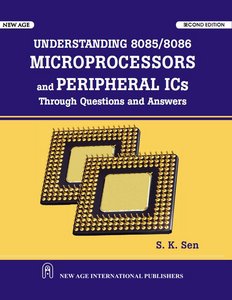
- Publisher: New Age Publications (Academic)
- Number Of Pages: 302
- Publication Date: 2009-04-30
- ISBN-10 / ASIN: 812242676X
- ISBN-13 / EAN: 9788122426762
Download
Mihd.net
Mediafire
Subscribe to:
Posts (Atom)
You might also like
